The church's interior
The iconostasis and the Melkites
What an iconostasis is, who made the one in Saint-Julien-le-Pauvre, how it was cut down and restored, and who the Melkites are.
Reserve your seat for the concert ↗Quick answer
The gilded wooden screen at the east end of Saint-Julien-le-Pauvre is an iconostasis, the icon screen of a Byzantine-rite church. It was made in Damascus by Girgi Bitar and inaugurated in 1891, trimmed in the 1950s and restored by 2012. The church has belonged to the Melkite Greek Catholic community since 1889.
What an iconostasis is
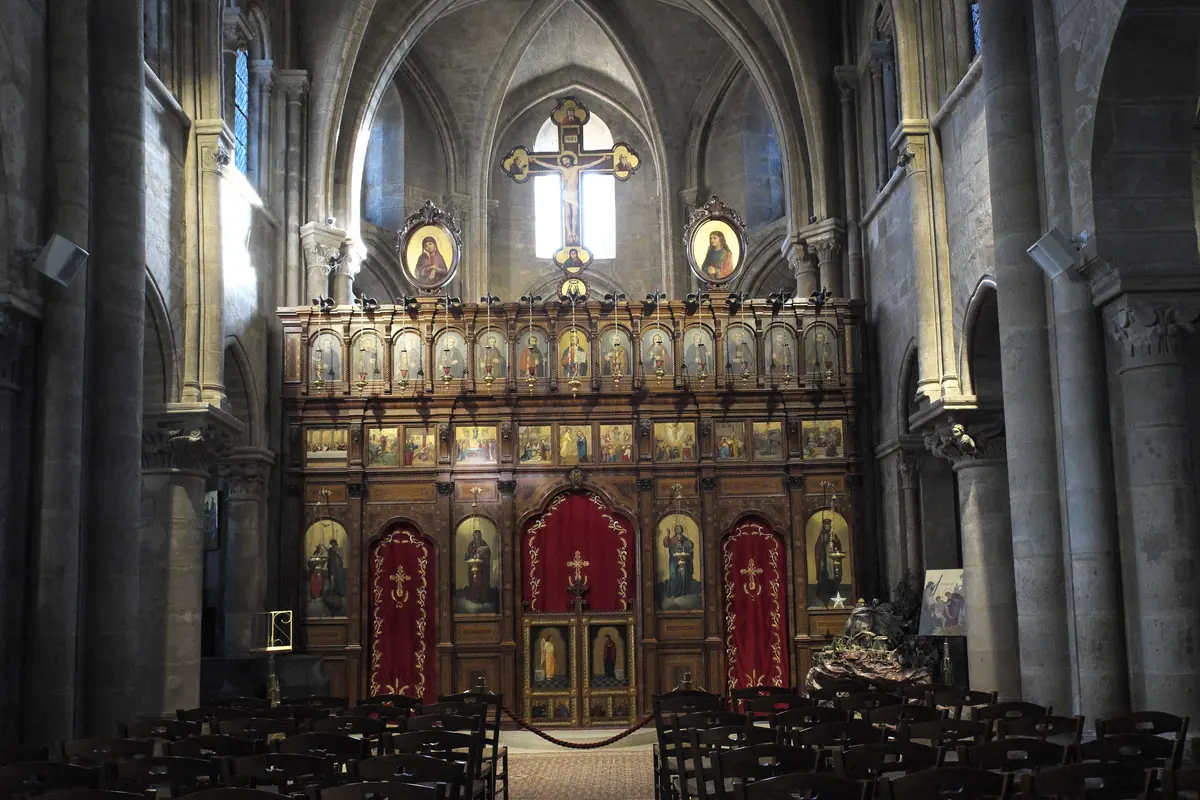
In the Byzantine rite, an iconostasis is the screen of painted icons that separates the sanctuary from the nave. It is not a barrier so much as a threshold, a place where the congregation and the altar meet. Most Western churches have no equivalent. Walk into Saint-Julien-le-Pauvre expecting a high altar and you meet this wall of icons and curtained doors instead, which is the first sign that the church belongs to a different tradition from the Gothic cathedral nearby.
Who made it
The iconostasis in Saint-Julien-le-Pauvre was made in Damascus, Syria, by the cabinetmaker Girgi Bitar, and it was inaugurated in 1891, two years after the Melkite community received the church. It is a carved wooden screen with tiers of painted icons, curtained doors and a cross above. A Paris church with a screen made in Damascus is a small fact about how far the community's links reach: the parish belongs to a church whose roots lie in the Christian community of Antioch.
Cut down, then restored
In the 1950s the rector of the day had the top of the iconostasis cut off to give a better view of the apse. That removed the upper tier, with its row of Apostles around Christ, and thirteen icons were taken out. In 2011 Gergi Bitar's grandson, Gaby Bitar, offered help to restore the screen to its original form. Eleven of the thirteen missing icons were found, a cabinetmaker and a restorer rebuilt the carved frame and painted the two that were missing, and the work was completed in 2012.
Who the Melkites are
The Melkite Greek Catholic Church is an Eastern Catholic church in full communion with Rome. It traces its roots to the Christian community of Antioch and split from the Chalcedonian Patriarchate of Antioch in 1724, when it entered communion with the Pope. It follows the Byzantine rite, the liturgical tradition also used by the Eastern Orthodox churches. The word Melkite comes from Syriac and Arabic words for king and royal. Its largest communities are in Lebanon and Syria, and the Paris parish at Saint-Julien dates from 1889.
Looking at it from your seat
At a concert the iconostasis is what you face. The icons are easiest to read in tiers: the lower row holds the large icons beside the central doors, and the higher tiers hold smaller scenes and figures. You do not need to know the saints to enjoy the colour of it, red curtains against dark carved wood, glowing in the lamps. Because the church is a place of worship, treat the screen as you would the stage of any sacred space: look closely, but keep your distance and do not touch. Photographs taken before a concert, with the chairs in place, show how close the front rows sit to the screen; if you can, choose a seat that lets you see the central doors.
A living parish
The church is not a museum. Services follow the Melkite parish's calendar, and the concert shares the nave with them. That is a good reason to arrive a little early, sit quietly and take the room in. It is also a reason to dress with some respect and to treat the building as the community's own.
Frequently asked questions
Is the iconostasis original to the church?
No. It was made in Damascus in the late 19th century and inaugurated in 1891, after the Melkite community received the church.
Can I get close to it?
At a concert you face it from your seat. The church is a place of worship, so keep your distance.
Was it ever damaged?
Its upper tier was cut away in the 1950s, and the screen was restored to its full form by 2012.
Sources